
FD vs Mutual Fund Calculator: Post-Tax Comparison
💡 Key Tips
- FD interest is taxed every year as it accrues, even in a cumulative FD where you receive nothing until maturity.
- Mutual fund gains are taxed only when you redeem. That deferral lets the untaxed amount keep compounding.
- Your tax slab changes the picture completely — move the slab slider to 0%, 20% and 30% and watch the gap shift.
- Equity funds get an annual long-term gains exemption; debt funds and FDs get none.
⚠️ Important Cautions
- The FD rate is contractual and known in advance. The fund return you enter is only an assumption — actual returns vary and can be negative.
- This is not a like-for-like risk comparison. Bank FDs carry deposit insurance up to a statutory limit; mutual funds carry market risk with no capital guarantee.
- Surcharge for high incomes, TDS timing, exit loads and expense ratios are not modelled here.
- Tax rules change. Check the current provisions before relying on any figure.
📋 Disclaimer
This calculator is provided for educational and informational purposes only. It does not constitute financial, investment, or tax advice, and it is not a recommendation to choose any product. Tax treatment depends on your individual circumstances and on rules that may change. Mutual fund investments are subject to market risks; read all scheme-related documents carefully. Consult a qualified financial adviser and a tax professional before making any investment decision.
📐 How the Post-Tax Maths Works
1. Fixed Deposit — taxed every year
2. Equity Mutual Fund — taxed once, at redemption
3. Debt Mutual Fund — taxed at your slab
4. Post-Tax CAGR
A fixed deposit paying 7% and a mutual fund expected to return 12% look like an easy comparison — until tax enters the picture. FD interest is taxed every year as it accrues; mutual fund gains are taxed only when you redeem. That single difference in timing changes the outcome as much as the headline rates do. This guide explains how each product is actually taxed under the rules in force for FY 2026-27, works through the numbers, and shows how to use the free EquityTimer FD vs Mutual Fund Calculator. Educational content only — no product recommendations.
What this comparison actually asks
“FD or mutual fund?” is really three questions wearing one coat, and they have different answers.
- Which is likely to grow more? A question about returns and about tax.
- Which is more certain? An FD rate is contractual and known on day one. A fund return is an expectation that may not arrive.
- Which suits the money? A goal fourteen months away and a goal fourteen years away call for different answers.
This article deals mainly with the first question, because it is the one where most people quietly get the arithmetic wrong — and it is the one a calculator can actually settle. The other two are matters of judgement, and the final tab returns to them.
The comparison most people make
The usual approach is to line up 7% against 12% and conclude the fund wins by five percentage points. Both figures are pre-tax, so the comparison is incomplete before it begins. What lands in your bank account depends on how much tax you pay and, just as importantly, when you pay it.
One caution before the numbers
Putting an FD and a mutual fund side by side implies they are alternatives of the same kind. They are not. A bank deposit is a contractual obligation of the bank, insured up to a statutory limit; a mutual fund is a market-linked instrument with no capital guarantee, whose return may be lower than expected or negative. Every number in this article assumes the fund delivers the return you enter — an assumption the FD does not require.
How a fixed deposit is taxed
FD interest is added to your total income and taxed at your income tax slab rate. The principal is not taxed — only the interest. Two details do most of the damage to post-tax returns.
1 · Tax is due as interest accrues, not when you receive it
In a cumulative FD you receive nothing until maturity, yet the interest credited each year is taxable in that year. So tax leaves your pocket annually while the deposit is still running. In practice this means only the post-tax portion of each year’s interest goes on to compound.
Here is what a 7% FD, compounded quarterly, is actually worth per year once slab tax is applied:
| Your tax slab | Effective post-tax rate |
|---|---|
| 0% (below taxable limit) | 7.19% |
| 5% | 6.81% |
| 10% | 6.44% |
| 20% | 5.69% |
| 30% | 4.94% |
The 7.19% at a 0% slab is higher than the advertised 7% because quarterly compounding lifts the nominal rate slightly. Every figure below it includes the 4% health and education cess charged on top of the tax.
2 · TDS is not the same as your tax
Banks deduct TDS at 10% once your interest from that bank crosses ₹50,000 in a financial year (₹1,00,000 if you are 60 or above). Without a PAN linked to the account, the rate is 20%. Two things are widely misunderstood here:
- The threshold is applied per bank, per PAN — across all your deposits at that bank, not per FD.
- TDS is only an advance collection. If you are in the 30% slab, the remaining tax is still yours to pay; if your total income is below the taxable limit, you can reclaim the TDS by filing a return.
A higher TDS threshold does not make interest tax-free. FD interest is fully taxable and must be declared even in years when the bank deducts nothing.
What you get in return for the tax drag
The rate is fixed and contractual, and deposits are covered by DICGC insurance up to ₹5,00,000 per depositor per bank, covering principal and interest together. That certainty is precisely what a market-linked product does not offer.
How mutual funds are taxed
Mutual fund tax depends on what the fund holds. Two categories matter for this comparison, and they are taxed very differently.
Equity funds
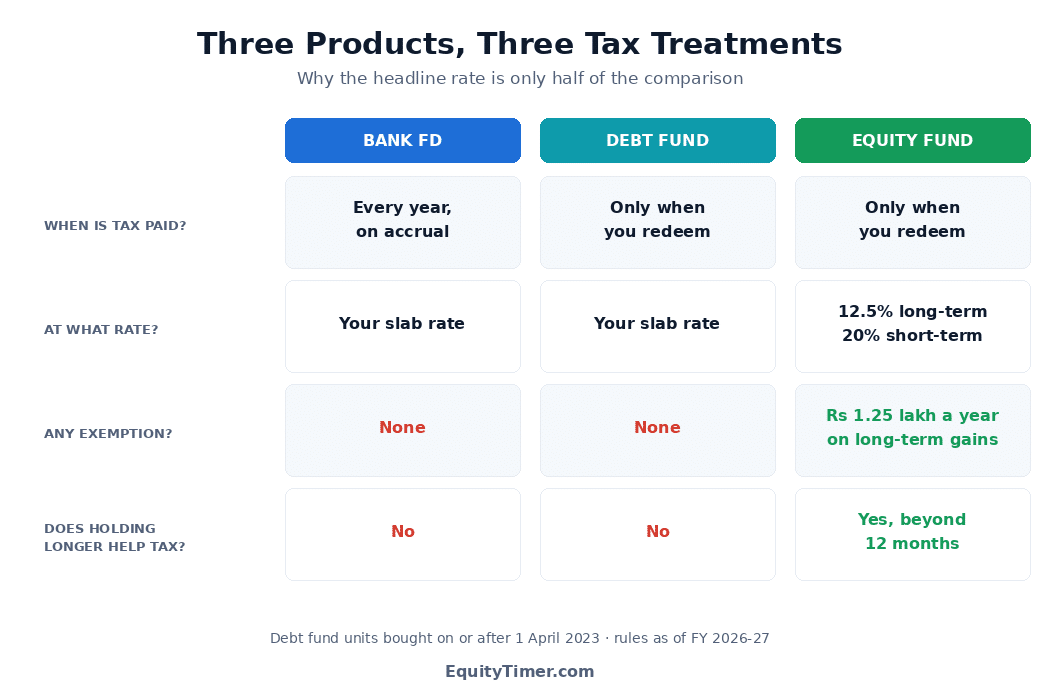
A fund that qualifies as equity-oriented is taxed on the gain you make when you redeem:
- Units held more than 12 months — long-term gains taxed at 12.5%, with the first ₹1.25 lakh of long-term gains in a financial year exempt.
- Units held 12 months or less — short-term gains taxed at 20%, with no exemption.
The rate does not depend on your income slab. A 30%-slab investor and a 5%-slab investor pay the same 12.5% on long-term equity gains.
Debt funds
For units bought on or after 1 April 2023, gains are treated as short-term no matter how long you hold them, and taxed at your slab rate, with no indexation and no exemption. Holding a debt fund for ten years gives no tax advantage over holding it for ten months.
That change removed the tax edge debt funds once had over deposits. One difference survives, and it turns out to matter: the tax falls only when you redeem.
| Bank FD | Debt fund | Equity fund | |
|---|---|---|---|
| Taxed when | Every year, on accrual | On redemption | On redemption |
| Rate | Slab | Slab | 12.5% long-term / 20% short-term |
| Exemption | None | None | ₹1.25 lakh a year on long-term gains |
| Longer holding helps? | No | No | Yes, beyond 12 months |
| Return | Contractual | Market-linked | Market-linked |
Rates above are the base rates. Health and education cess of 4% applies on top, and a surcharge may apply at higher income levels. Dividend (IDCW) payouts are a separate matter — they are added to your income and taxed at slab, whichever type of fund pays them.
The timing effect, isolated
To see what deferral alone is worth, strip the return difference out entirely. Compare an FD and a debt fund earning exactly the same effective annual rate, taxed at the same 30% slab. The only difference left is when the tax is collected.
| Holding period | FD (taxed yearly) | Debt fund (taxed at exit) | Difference |
|---|---|---|---|
| 3 years | ₹11,55,771 | ₹11,59,230 | +₹3,459 |
| 5 years | ₹12,72,876 | ₹12,85,367 | +₹12,491 |
| 10 years | ₹16,20,213 | ₹16,89,099 | +₹68,886 |
| 15 years | ₹20,62,330 | ₹22,60,290 | +₹1,97,960 |
Both sides earn 7.19% a year on ₹10,00,000 and both pay 30% tax. Over three years the deferral is worth about ₹3,500 — barely noticeable. Over fifteen years it is worth nearly ₹2 lakh. The money the FD hands to the tax department each year is money that stops compounding; in the fund, that same amount keeps working until you sell.
Why the effect grows
It compounds. In year one the difference is a single year’s tax. In year two it is that amount plus the growth it would have produced, plus the new year’s tax. The gap therefore widens faster the longer the money stays invested, which is why deferral is close to irrelevant for a two-year goal and substantial for a fifteen-year one.
This isolates timing only. It assumes the debt fund actually delivers the same return as the FD — which is not guaranteed, and is the whole risk difference between the two.
The numbers side by side
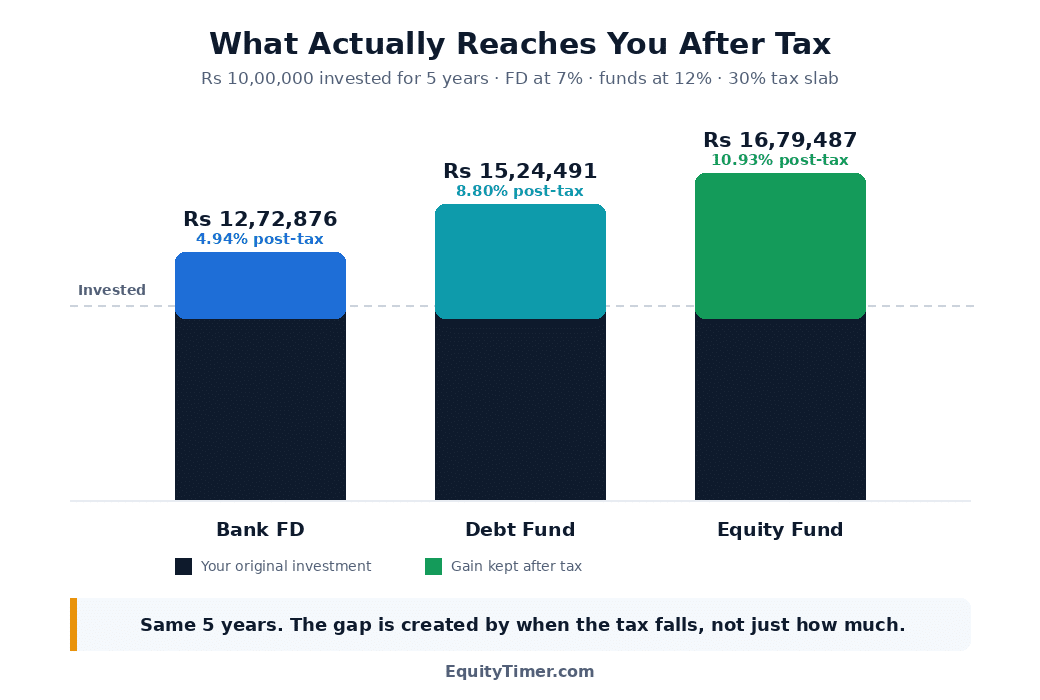
Now put realistic assumptions in: ₹10,00,000 invested for 5 years, an FD at 7%, and both funds assumed to return 12% a year.
How the slab changes everything
| Tax slab | FD post-tax | Debt fund post-tax | Equity fund post-tax |
|---|---|---|---|
| 0% | ₹14,14,778 | ₹17,62,342 | ₹16,79,487 |
| 5% | ₹13,90,289 | ₹17,22,700 | ₹16,79,487 |
| 10% | ₹13,66,140 | ₹16,83,058 | ₹16,79,487 |
| 20% | ₹13,18,848 | ₹16,03,775 | ₹16,79,487 |
| 30% | ₹12,72,876 | ₹15,24,491 | ₹16,79,487 |
Three patterns are worth reading out of that table.
- The FD column falls steadily with the slab — from ₹14.15 lakh at 0% to ₹12.73 lakh at 30%. Slab tax is the single biggest drag on an FD.
- The equity column never moves. At 12.5% flat plus cess, an equity fund’s post-tax outcome is the same whatever you earn.
- The debt and equity columns cross over. At a slab of about 10.45% they are level. Below that, the debt fund keeps more; above it, the equity fund does. That crossover exists purely because of tax, not because of returns — both funds are assumed to earn the same 12%.
The break-even question
Turn it around and ask what return a fund would need merely to match the FD after tax. At a 30% slab over five years, an FD at 7% is matched by an equity fund returning about 5.31% a year, or a debt fund returning about 6.91%. The equity figure is strikingly low: a fund could underperform the FD by well over a percentage point in gross terms and still leave you with more, because of the flat 12.5% rate and the exemption.
This is a tax observation, not a prediction. It says nothing about whether any fund will deliver 5.31% or 12% — and, unlike the FD rate, that number is never known in advance.
How to use the comparison calculator
The EquityTimer FD vs Mutual Fund Calculator is free, needs no login, and recalculates as you move any slider.
| Field | What to enter |
|---|---|
| Investment Amount | The lump sum you would put into either option |
| FD Interest Rate | The rate your bank is actually quoting for that tenure |
| Expected Fund Return | Your assumption for the fund — treat this as a scenario, not a forecast |
| Investment Period | How long the money stays invested, in years |
| Income Tax Slab | Your marginal slab rate — the rate on your next rupee of income |
| Fund Type | Equity or debt — this switches the whole tax treatment |
Reading the results
- The green panel shows the post-tax gap between the two options and states plainly which one ends ahead.
- The four metrics give each option’s final post-tax value and its post-tax CAGR — the annual growth rate actually left in your hands.
- The donut splits the two post-tax gains, with total tax paid across both shown beneath.
- The year-wise table assumes you exit at the end of each year, so you can see when the fund overtakes the FD — or fails to.
Three experiments worth running
- Drag the slab slider from 30% to 0%. Watch the FD close most of the gap. If you are below the taxable limit, an FD is far more competitive than the usual comparison suggests.
- Set the fund return equal to the FD rate. Whatever advantage remains is pure tax deferral — nothing to do with better returns.
- Set the period to 1 year with an equity fund. The 20% short-term rate applies and the picture changes sharply, which is exactly why holding period matters for equity.
Choosing between them
The calculator answers the arithmetic. It cannot answer whether an assumed return is reasonable, or whether you could tolerate the path to it. Those depend on the money’s job.
Match the product to the horizon
| Time until you need the money | What matters most |
|---|---|
| Under 1 year | Capital certainty. Equity gains are taxed at 20% here anyway, and a market fall over such a short window cannot be waited out. |
| 1 to 3 years | Certainty still dominates. Tax deferral is worth very little over this span. |
| 3 to 5 years | The deferral effect begins to register, but a market-linked option can still be down when the deadline arrives. |
| Beyond 5 years | Deferral and the flat equity rate compound meaningfully — provided the return assumption holds and you can sit through drawdowns. |
Questions the calculator cannot answer for you
- Is the return assumption honest? Entering 15% does not make 15% likely. Look at what the category has actually delivered over long periods, and remember that past performance does not indicate future results.
- Could you hold through a fall? A fund that ends higher after five years may be 25% down in year two. Selling at that point converts a paper loss into a real one.
- When exactly do you need the money? A fixed deadline and a volatile asset combine badly.
- What about liquidity? Breaking an FD early usually costs a penalty on the rate. Most open-ended funds can be redeemed in a few working days, though exit loads may apply.
It is not always one or the other
Many people hold both, and use each for what it is good at — deposits for money with a near, fixed deadline and for an emergency buffer, market-linked funds for goals far enough away that volatility has time to matter less. Splitting by purpose is a common approach, and it sidesteps the false premise that one product has to win outright.
EquityTimer publishes factual, educational tools and data only. It is not a SEBI-registered investment adviser, and nothing here is a recommendation to buy, sell or hold any product.
Frequently asked questions
Is a mutual fund always better than an FD after tax?
No. The comparison depends on three things you control in the calculator: your tax slab, the holding period, and the return the fund actually delivers. At a 0% slab an FD keeps far more of its interest, and over short periods the tax-deferral advantage is small. Above all, the FD rate is contractual while the fund return is an assumption — if the fund underperforms your assumption, the arithmetic changes completely.
How is FD interest taxed in India?
FD interest is added to your total income and taxed at your income tax slab rate, plus 4% health and education cess. It is taxable in the year it accrues, even in a cumulative FD where you receive nothing until maturity. The principal itself is not taxed — only the interest.
When does the bank deduct TDS on FD interest?
Banks deduct TDS at 10% once your interest from that bank crosses ₹50,000 in a financial year, or ₹1,00,000 if you are a senior citizen aged 60 or above. The threshold applies per bank per PAN, across all your deposits with that bank, not per individual FD. Without a PAN linked to the account, TDS is deducted at 20%. TDS is not your final tax liability — you may owe more when filing, or be able to claim a refund if your total income is below the taxable limit.
Are debt mutual funds still more tax-efficient than FDs?
Only in timing. For units bought on or after 1 April 2023, debt fund gains are taxed at your slab rate regardless of holding period, with no indexation — the same rate an FD faces. What survives is that the tax falls only when you redeem, so the untaxed amount keeps compounding in the meantime. Over three years that is worth very little; over fifteen years it becomes substantial.
How are equity mutual funds taxed?
Units held for more than 12 months attract long-term capital gains tax at 12.5%, with the first ₹1.25 lakh of long-term gains in a financial year exempt. Units held for 12 months or less are taxed at 20% as short-term gains, with no exemption. Both rates carry 4% cess on top. Unlike FD interest and debt fund gains, these rates do not vary with your income slab.
Does my tax slab affect equity fund returns?
No. Long-term equity gains are taxed at a flat 12.5% whatever your income. This is why the equity column in the comparison table stays unchanged across every slab, while the FD and debt fund columns fall as the slab rises. It also means the post-tax case for equity funds strengthens as your income rises.
Is my money safer in an FD than in a mutual fund?
They carry different kinds of risk. Bank deposits are covered by DICGC insurance up to ₹5,00,000 per depositor per bank, including principal and interest, and the interest rate is contractually fixed. Mutual funds carry market risk with no capital guarantee, and their value can fall. An FD offers certainty of outcome; a fund offers the possibility of a higher outcome without any assurance of it.
What return would a fund need just to match an FD after tax?
Using the article’s example — ₹10,00,000 for 5 years at a 30% slab against an FD at 7% — an equity fund would need roughly 5.31% a year and a debt fund roughly 6.91% to finish level after tax. The equity figure is lower because of the flat 12.5% rate and the annual exemption. Change the slab, the period or the FD rate in the calculator and the break-even moves.
Educational and informational content only. EquityTimer is not a SEBI-registered investment adviser and does not provide buy, sell or hold recommendations. Tax rates described are the base rates in force for FY 2026-27 and exclude surcharge; treatment depends on your individual circumstances and rules may change. Mutual fund investments are subject to market risks; read all scheme-related documents carefully. Verify all figures independently and consult a qualified financial adviser and a tax professional before making any investment decision.