
Stock Market Calendar
Buyback India
TodayData shown for informational and educational purposes only, sourced from public exchange disclosures. Dates and amounts are as announced by companies and may be revised. This is not investment advice. EquityTimer is not a SEBI-registered investment adviser.
A stock market calendar lists the dates that matter to shareholders — company results, dividends, bonus issues, stock splits, rights issues, buybacks and other corporate actions, plus major economic events. This guide explains what each event means, how ex-dates and record dates work under India’s T+1 settlement, and how to read the EquityTimer calendar across the Indian (NSE/BSE) and US (Nasdaq) markets. It is written for education and research only — factual dates and data, with no buy, sell or hold advice.
What a stock market calendar shows
A stock market calendar is a single, dated view of the events that can affect a listed company and its shareholders. Instead of hunting through dozens of company announcements, you see everything scheduled — today, this week or this month — in one place. The EquityTimer calendar is organised into two calendars you can switch between:
- Stock Results & Events — company-level dates: board-meeting results, dividends, bonus issues, stock splits, rights issues, buybacks, mergers and capital reductions.
- Economic Calendar — economy-wide releases: central-bank rate decisions, inflation, jobs and growth data, with expected, actual and previous figures.
Each calendar can be viewed for India (NSE- and BSE-listed companies) or the United States (Nasdaq), and filtered by date range. The table below summarises the company-level event types the calendar tracks.
| Event type | What it means |
|---|---|
| Results | A scheduled board meeting to approve and publish quarterly or annual financial results. |
| Dividend | A cash payout to shareholders from the company’s profits, quoted per share. |
| Bonus | Free additional shares issued to existing shareholders in a set ratio. |
| Split | Each share is divided into more shares of smaller face value; total holding value is unchanged. |
| Rights | An offer letting existing shareholders buy new shares, usually at a discount, in proportion to their holding. |
| Buyback | The company repurchases its own shares from the market or shareholders. |
| Merger | A restructuring in which companies combine, or a unit is spun off or amalgamated. |
| Capital reduction | A formal reduction of the company’s share capital, sometimes returning cash to holders. |
Ex-date and record date explained
Two dates decide whether you actually receive a dividend, bonus or other benefit: the record date and the ex-date. They are simple once you see how they fit together.
- The record date is the day the company checks its shareholder register. If your name is on the register that day, you are eligible for the corporate action.
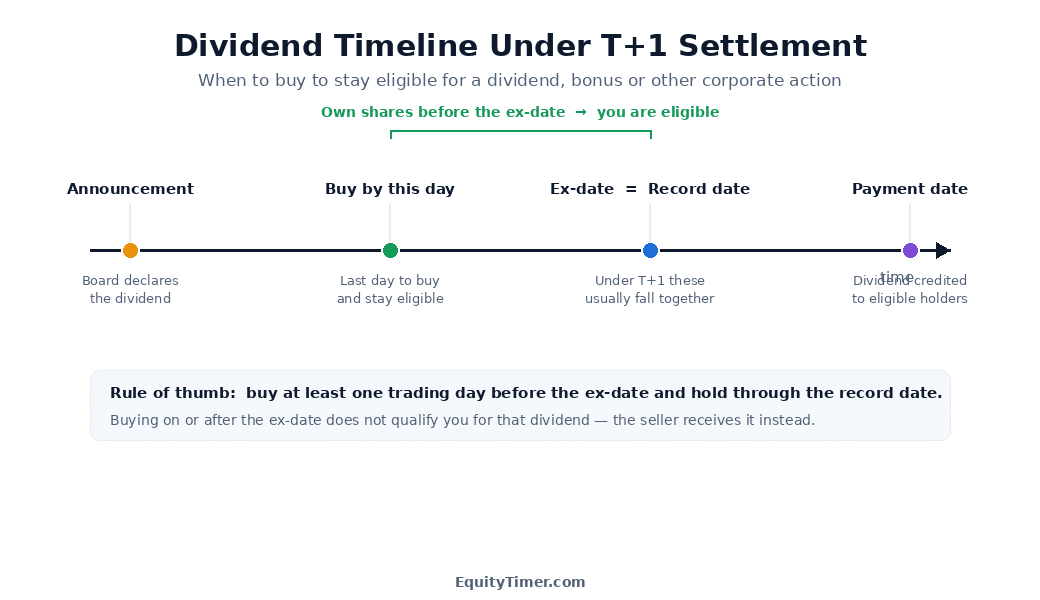
- The ex-date (ex-dividend date) is the practical cut-off for buyers. Buy before the ex-date and you are eligible; buy on or after it and you are not — the seller keeps the benefit.
Why T+1 makes them line up
Indian markets settle on a T+1 basis — a trade completes one working day after it is placed. Because of this, the ex-date and record date now commonly fall on the same day. In practice, to stay eligible you need to own the shares at least one trading day before the ex-date and hold them through it, so the transfer is settled and your name is on the register in time. This is exactly why the calendar shows an ex-date and a record date that are often identical — it reflects how settlement actually works, not an error.
A worked example
Suppose a company declares a dividend with a record date of Wednesday. Under T+1 the ex-date is effectively the same Wednesday. To be eligible you must have bought by Tuesday so the shares settle into your account in time. Buy on Wednesday itself and the trade settles too late — you miss that dividend, and whoever sold you the shares receives it. The share price also tends to adjust downward on the ex-date by roughly the dividend amount, since new buyers will not receive the payout.
Dividends, bonus, splits, rights & other actions
“Corporate actions” are decisions a company takes that affect its shares. Here is what each one on the calendar means, in plain terms, and why the dates matter.
Dividend
A share of profits paid in cash, quoted as an amount per share. Dividends may be interim (declared during the year), final (approved at the annual general meeting) or special (a one-off). Eligibility follows the ex-date and record date described in the previous tab.
Bonus issue
Free extra shares in a fixed ratio — for example, one bonus share for every two held (a 1:2 bonus). Your number of shares rises while the price adjusts proportionally, so the total value of your holding is broadly unchanged on the day.
Stock split
A share is divided into several shares of smaller face value — say one ₹10 share becoming five ₹2 shares. The company’s value does not change; the shares simply become more numerous and individually cheaper, which can improve affordability and liquidity.
Rights issue
An invitation to existing shareholders to buy new shares, usually at a discount to the market price, in proportion to what they already hold. It is a way for the company to raise fresh capital from its own investors.
Buyback
The company repurchases its own shares, reducing the number in circulation. Companies do this to return surplus cash to shareholders or to consolidate ownership.
Merger & capital reduction
A merger (or amalgamation, or spin-off) restructures how companies or divisions are combined or separated. A capital reduction formally lowers the company’s share capital, sometimes returning cash to holders. Both are less frequent but appear on the calendar when scheduled.
How to track results and earnings dates
A company’s results (called earnings in the US) are among the most watched dates on any market calendar, because they reveal how the business actually performed.
India: forthcoming results
Indian companies announce a board meeting date at which quarterly or annual results will be approved and published. The calendar’s Results tab lists these forthcoming board meetings — the company name and the scheduled date — so you can see which companies report and when. The figures themselves are released on the meeting day.
US: earnings with consensus estimates
For US companies, the calendar shows scheduled earnings dates along with a consensus EPS — the average earnings-per-share figure analysts expect. Comparing the reported result against this expectation is a large part of how the market reacts to US earnings.
India results do not carry a consensus EPS figure. Broad analyst-estimate data of that kind is not published in the same freely available way for Indian companies, so the calendar shows the scheduled date without an expectation column — a factual difference between the two markets, not a missing feature.
Reading the economic calendar
The Economic Calendar tracks economy-wide events rather than single companies — the releases that can move whole markets. Typical entries include central-bank interest-rate decisions (the RBI in India, the Federal Reserve in the US), inflation (CPI), employment data and growth (GDP) figures.
Expected, actual and previous
Each economic event shows up to three figures:
- Expected — the consensus forecast before the release: what economists, on average, anticipate.
- Actual — the figure once officially published.
- Previous — the value from the prior period, for context.
The gap between expected and actual is what markets react to: a result far from the forecast is a “surprise” that can move currencies, bonds and equities. The EquityTimer economic calendar can be viewed for all countries at once or filtered to a single country, and the expected figure is shown where a published consensus is available.
How to use the EquityTimer calendar
The calendar above this article is free and needs no login. Here is how to get around it.
1 · Choose the calendar type
Use the tabs at the top to switch between Stock Results & Events and the Economic Calendar. Each opens its own view for the same country.
2 · Pick a country
Toggle between India and USA. India shows NSE/BSE corporate actions and results; the US view shows Nasdaq dividends, splits and earnings. Selecting a country opens its own clean page.
3 · Choose an event type
Within Stock Results & Events, the left rail lists each event type — Dividend, Results, Bonus, Split, Rights, Buyback, Merger, Capital Reduction — with a live count beside it. Click one to see only those events.
4 · Set a date range
Use the range chips — Today, Next 7 days, Next 30 days, Next 60 days — to widen or narrow the window. Dates are grouped into day-by-day accordions you can expand.
5 · Filter the economic calendar by country
On the Economic Calendar, a country dropdown lets you see every country’s events together or narrow to one — India, USA and others.
What’s covered for India and the US
The calendar covers two markets, and the two are not identical — some event types exist for India but have no equivalent scheduled feed in the US. The table shows what appears for each.
| Event | India (NSE/BSE) | United States (Nasdaq) |
|---|---|---|
| Results / earnings | Yes — forthcoming board meetings | Yes — with consensus EPS |
| Dividend | Yes | Yes |
| Stock split | Yes | Yes |
| Bonus | Yes | India only |
| Rights | Yes | India only |
| Buyback | Yes | India only |
| Merger | Yes | India only |
| Capital reduction | Yes | India only |
Why some are India-only
Bonus issues, rights issues, buybacks, mergers and capital reductions are published as scheduled corporate-action events by the Indian exchanges, so the calendar can list them with dates. In the US, those same actions are disclosed through regulatory filings rather than a dated calendar feed, so there is no equivalent scheduled list to show — the US view focuses on dividends, splits and earnings, which do have reliable calendar data.
India corporate-action and results data is sourced from the BSE; US dividend, split and earnings data from Nasdaq. Dates and amounts are as announced by companies and exchanges and may be revised.
Frequently asked questions
What is a stock market calendar?
A stock market calendar is a dated list of events that affect listed companies and their shareholders — company results, dividends, bonus issues, stock splits, rights issues, buybacks and other corporate actions, together with major economic releases such as interest-rate decisions and inflation data. It lets you see, in one place, what is scheduled today, this week or this month.
What is the difference between the ex-date and the record date?
The record date is the day a company checks its register to see who owns its shares; anyone listed that day is eligible for the dividend or other benefit. The ex-date is the buyers’ cut-off: buy before the ex-date and you qualify, buy on or after it and you do not. The ex-date exists because share purchases take time to settle, so it marks the last point at which a new buyer can still be recorded as an owner in time.
When should I buy a stock to receive a dividend?
Under India’s T+1 settlement, eligibility requires owning the shares at least one trading day before the ex-date and holding them through it, so the trade settles and your name is on the register by the record date. Buying on or after the ex-date means the trade settles too late and you will not receive that dividend. This is general educational information, not advice on any specific stock.
Are the ex-date and record date the same in India?
Very often, yes. Since Indian markets moved to a T+1 settlement cycle, the ex-date and record date commonly fall on the same day. That is why a calendar may show identical ex-dates and record dates — it reflects the current settlement mechanism rather than an error. The practical rule stays the same: own the shares before that shared date.
Does the calendar cover both Indian and US stocks?
Yes. You can switch between India (NSE- and BSE-listed companies) and the United States (Nasdaq). India shows the full range of corporate actions plus forthcoming results; the US view shows dividends, stock splits and earnings dates with consensus EPS. An economic calendar for both markets is also available.
Is this stock market calendar investment advice?
No. The calendar presents factual, scheduled dates and publicly announced figures for educational and informational purposes only. It does not tell you what to buy, sell or hold. EquityTimer is not a SEBI-registered investment adviser; dates and amounts are as announced by companies and exchanges and may be revised. Always verify independently and consult a registered adviser before investing.
Educational and informational content only. Dates and amounts shown are as announced by companies and exchanges and may be revised. EquityTimer is not a SEBI-registered investment adviser and does not provide buy, sell or hold recommendations. Verify independently and consult a registered financial adviser before making any investment decision.