
The 5 Types of AI Companies Every Investor Should Know
Are you looking for AI stocks to invest globally? You are in the right place. This article will help you to understand how to choose and invest in different companies in the AI field. If you have no time to read, then just listen to the audio form of the article.
AI is being sold as one single idea. It is not. Behind every chatbot sits five very different kinds of business — and only some of them are making real money today. Here is the simple map, backed by the latest numbers.
If you don’t have time to read, then listen to a podcast.
[ez-toc]
“Invest in AI” is not one decision — it is five
When someone says “put money into AI,” it is a little like saying “invest in petrol.” Do you mean the company that drills the crude oil, the one that runs the fuel pumps, or the one that makes the tyres? All three are linked to the same industry, but each earns money in a completely different way, and each carries a different risk.
AI works the same way. There is no single “AI company.” There are at least five types of companies, each at a different level of the AI chain and with its own business model. Before you buy a single share, it helps to know which type you are actually looking at — because that is what separates a real business from a bet on a story.
This guide walks through all five types in plain English and shows, with current data, where the cash is real today and where it still depends on the future.
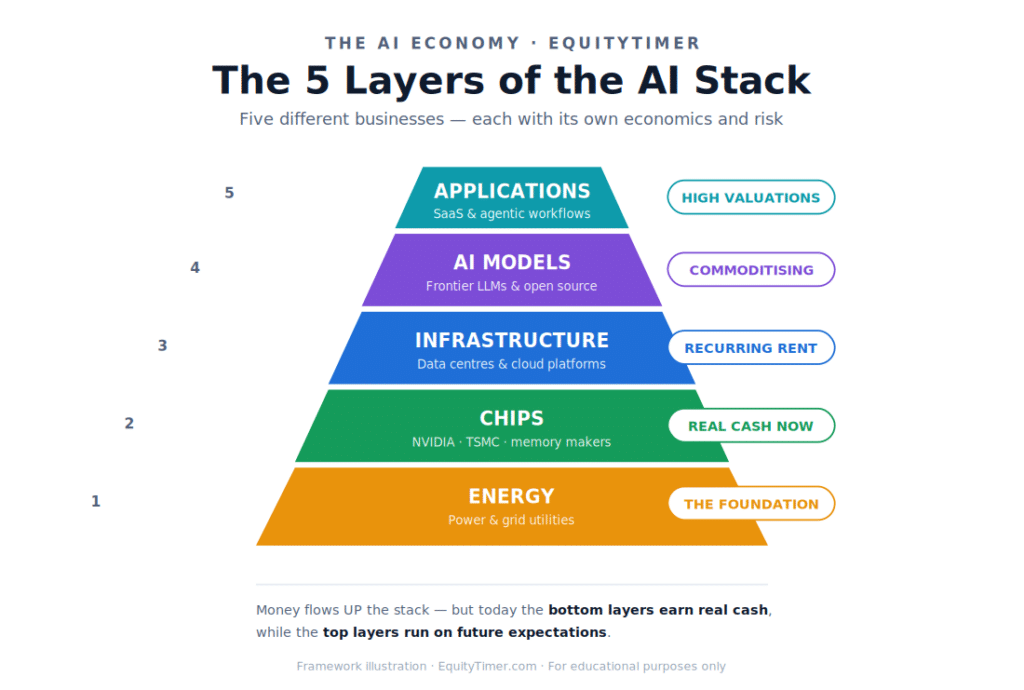
Figure 1: The five types of AI companies, stacked from the foundation up. Money flows upward, but the lower levels earn real cash today while the upper levels trade on expectations.
1. The Power Suppliers (Energy)
Every AI question you type runs on thousands of servers, and every server needs electricity around the clock. The companies that generate power and own the grid sit at the very bottom of the chain, and they get paid no matter which AI model finally wins.
The demand is huge. Across the five biggest spenders — Alphabet, Amazon, Meta, Microsoft, and Oracle — combined spending on AI infrastructure rose from about 162 billion dollars in 2022 to roughly 448 billion dollars in 2025. The four largest are now guiding toward nearly $ 725 billion in 2026. A large part of that money goes into data centers, and data centers, above everything else, need power.
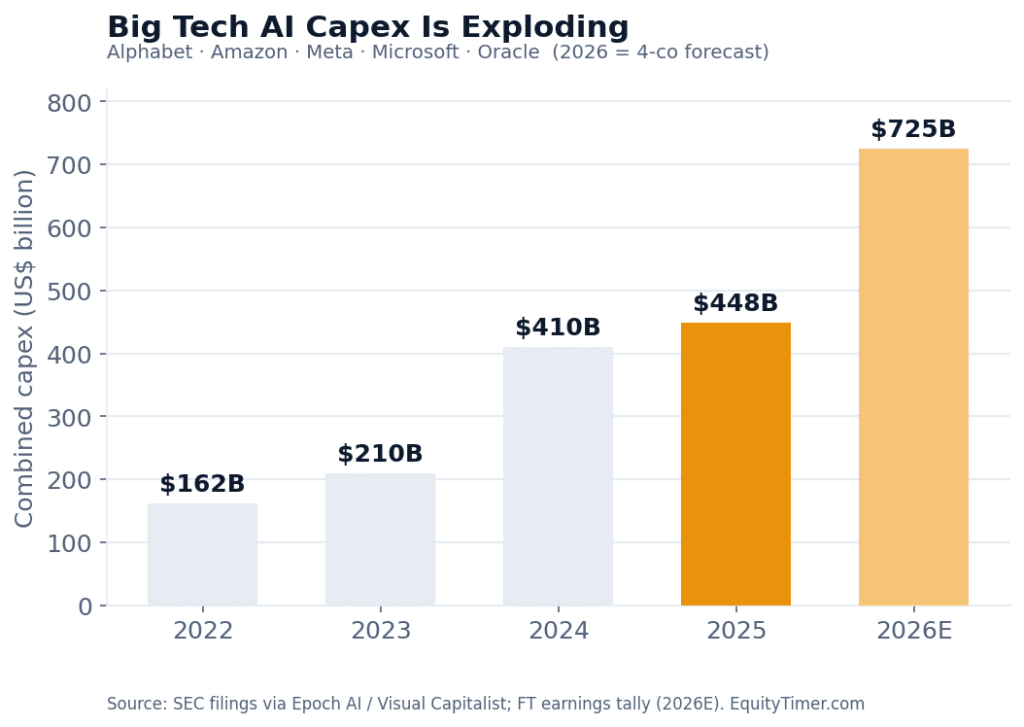
Figure 2: Combined AI spending by the major cloud companies. The 2026 figure is a four-company forecast from first-quarter earnings. Sources: SEC filings via Epoch AI / Visual Capitalist; Financial Times earnings tally.
The economics: steady, regulated, and tied to physical assets. The catch is that building new power capacity is slow, and in some regions, the electricity grid itself is now the bottleneck holding back new data centers.
2. The Chip Makers (the “Pickaxe Sellers”)
In a gold rush, the surest profits often go not to the miners but to the people selling the pickaxes and shovels. In AI, the pickaxe sellers are the chip companies — and right now, this is where the most obvious real money is being made.
NVIDIA designs the special processors that AI models run on. Its revenue has roughly tripled in two years: about 61 billion dollars in its 2024 financial year, 130 billion in 2025, and 216 billion in 2026, with the data-center part alone reaching around 194 billion dollars and gross margins above 70 percent. This is not a promise of future profit. It is cash arriving today.
NVIDIA does not build its own chips — TSMC in Taiwan does. TSMC had another record year, with revenue of about 122 billion dollars and net profit of around 55 billion dollars in 2025, helped by AI demand. NVIDIA became TSMC’s single largest customer that year. A third group — SK Hynix, Samsung, and Micron — makes the special high-bandwidth memory that AI chips need, and much of that supply is booked far in advance.
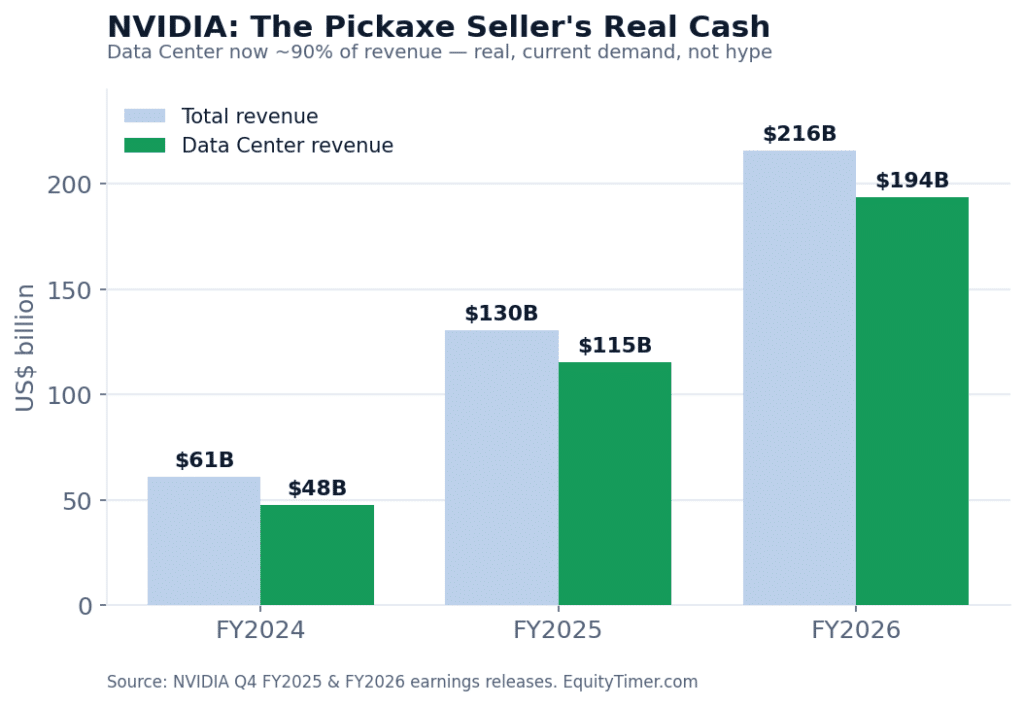
Figure 3: NVIDIA’s revenue, with the data-center segment now close to 90 percent of the total. Source: NVIDIA Q4 FY2025 and FY2026 earnings releases.
The economics: real orders, real shortages, and real cash flow on the balance sheet — but this is a cyclical industry, where today’s shortage can become tomorrow’s oversupply.
3. The Infrastructure Builders (Cloud “Landlords”)
Once you have chips and power, someone has to put them together into data centers and rent them out. That is the cloud business — Amazon (AWS), Microsoft (Azure), Google Cloud, and Oracle. They build the digital warehouses of the AI age and lease the space to everyone, from large AI labs to small startups.
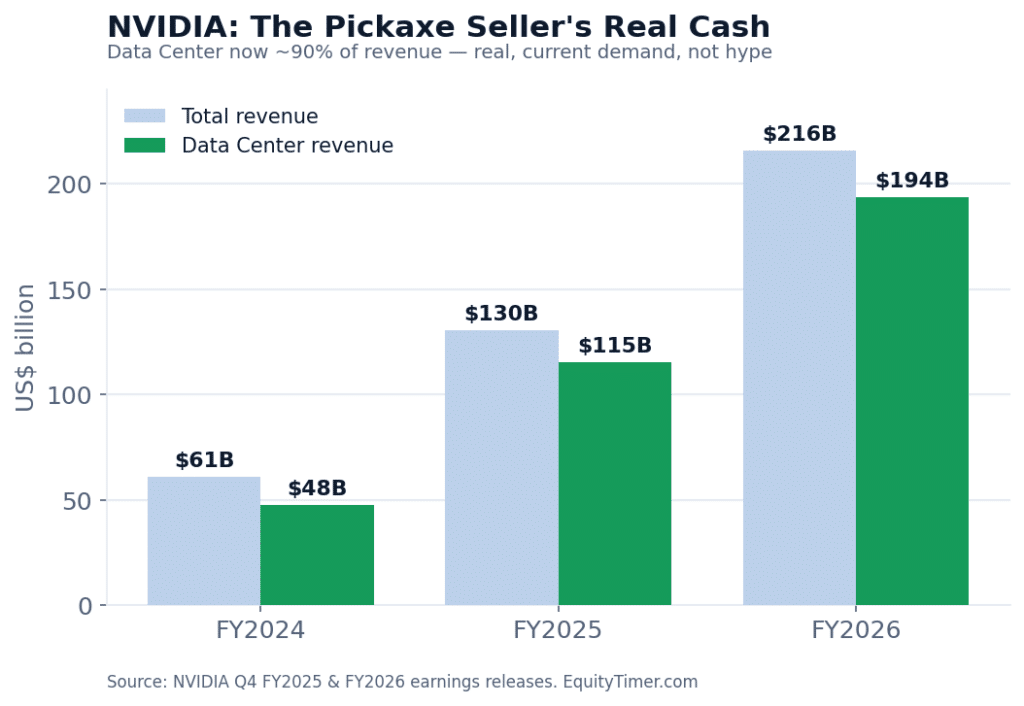
Figure 4: Approximate yearly cloud revenue. These are real, recurring businesses — but they account for the heaviest spending of any layer. Source: company cloud-segment disclosures, FY2025–26.
The economics: genuine, repeating revenue — but the huge upfront cost of building data centers means these firms are taking on heavy spending and, increasingly, debt. We look at that pressure in Part 2 of this series.
4. The Model Builders (the “Brains”)
This is the layer most people picture when they hear the word “AI”: OpenAI’s ChatGPT, Anthropic’s Claude, Google’s Gemini, and China’s DeepSeek. These companies build the actual intelligence. But for an investor, two problems stand out.
First, the two best-known pure AI labs — OpenAI and Anthropic — are not publicly traded, so you cannot buy their shares directly. Second, the economy is under pressure. When a Chinese lab can release a model that performs almost as well as a top US model at a small fraction of the cost, it suggests the product is slowly becoming a commodity. Today’s premium service can become tomorrow’s cheap utility.
The economics: the heart of the revolution, but fierce competition and falling costs are squeezing model makers’ pricing power.
5. The Application Companies (Everyday AI)
At the top sit the application companies, where people actually use AI in daily work. Microsoft has built AI into its Office tools, Adobe into photo editing, Salesforce into its sales software, and a wave of startups is adding AI features to almost everything else.
The economics: possibly the biggest long-term opportunity, because this is where AI turns into real productivity and revenue. But many of these companies trade at very high valuations and face strong competition, so the gap between promise and proof can be wide.
The five types at a glance
Here is a simple side-by-side view of all five types, with one verified data point for each so you can see where the real cash sits today.
| Type of company | Example names | Cash real today? | Key data point (verified) |
| 1. Power Suppliers | Grid & utility firms | Yes (indirect) | Powers ~725 bn dollars of planned 2026 AI capex |
| 2. Chip Makers | NVIDIA, TSMC, memory makers | Yes — strongest | NVIDIA revenue 216 bn dollars (FY26); TSMC net profit ~55 bn dollars (2025) |
| 3. Infrastructure Builders | AWS, Azure, Google Cloud, Oracle | Yes — but heavy spending | Cloud divisions earn tens of billions yearly; capex is rising fast |
| 4. Model Builders | OpenAI, Anthropic, Google, DeepSeek | Mixed / under pressure | Top labs (OpenAI, Anthropic) are not listed; costs are falling fast |
| 5. Application Companies | Microsoft, Adobe, Salesforce, startups | Growing, but pricey | Large long-term potential, but high valuations and competition |
Table 1: A plain-English summary of the five AI company types. Figures are from company filings and reputable financial press as of June 2026. For education only — not a buy or sell list.
One simple rule that ties it all together
Here is a test you can apply to any company in any of the five types: does it have real customers, send real invoices, and receive real cash today? A company that is now billing customers is showing signs of a real business. A company whose value rests only on what AI might earn in five years is asking you to trust a story.
Right now, that test is best met by the first two types — the power suppliers and the chip makers — where shortages and order books are visible on the balance sheet. It gets harder to pass as you move up toward the model builders and application companies, where valuations lean more on future hopes.
This does not make any one type good or safe by itself. It simply means the kind of risk you take is different for each type — and knowing which type of company you are buying is the whole point.
Read More also in this series
Part 2 — AI Bubble or Real Growth? The cash-flow, spending, and debt data behind both arguments.
Part 3 — How to Invest in US AI Stocks from India. The practical steps: the LRS route, fractional shares, and taxes.
Frequently Asked Questions (FAQ)
What are the main types of AI companies?
Broadly, there are five: power suppliers (energy and grid), chip makers (such as NVIDIA and TSMC), infrastructure builders (cloud platforms like AWS and Azure), model builders (such as OpenAI, Google, and Anthropic), and application companies (software that puts AI in front of users). Each earns money differently.
Which type of AI company makes real money today?
As of 2026, the chip makers show the clearest real cash, with NVIDIA and TSMC reporting record revenue and high margins driven by AI demand. Cloud infrastructure firms also earn real, repeating revenue, but they spend very heavily to build data centers.
Can I invest in OpenAI or Anthropic directly?
No. As of June 2026, OpenAI and Anthropic are private companies and are not listed on the stock market, so you cannot buy their shares directly. Investors usually get indirect exposure through their larger partners and backers.
Is it possible to invest in these US AI companies from India?
Yes. Indian residents can invest in US-listed companies through the Liberalized Remittance Scheme (LRS) via platforms that offer US stocks, often with fractional shares. We cover the full process, including taxes, in Part 3 of this series.
Are AI stocks a safe investment?
No stock is fully safe. AI-linked companies can be volatile, and valuations in some layers are high. The risk is different for each of the five types. This article is for education only and is not investment advice; please do your own research and speak to a SEBI-registered adviser before investing.
Disclaimer
EquityTimer is an educational resource and is not registered with SEBI as an investment adviser. Nothing in this article is investment advice, nor a recommendation to buy, sell, or hold any security. Company names and figures are used only for illustration and analysis. All data is taken from public company filings and reputable financial press as of June 2026 and may change. Please do your own research and consult a SEBI-registered adviser before investing.