
Delta Hedging & Delta-Neutral Trading on Nifty: A Practical Guide
If you don’t have time to read, then just listen to the audio guide about Delta Hedging & Delta-Neutral Trading,
About this article: This is the practical half of our two-part Delta series — what traders actually do with Delta. You will learn how to add Deltas across multiple positions into a single position Delta that reveals your true directional exposure; what a delta-neutral position is and why market makers live in that state; the exact shares-to-hedge formula (Delta × contracts × lot size) with a worked Nifty example using the current lot size; the difference between static and dynamic hedging and why hedges drift; the situations where Indian traders typically hedge (RBI policy, Budget day, expiry week); and the practical cautions — costs, model differences and settlement rules — that decide whether hedging helps or hurts. A short FAQ answers the most common hedging questions. New to Delta? Start with Part 1: the beginner’s guide.
A 30-second recap
If you skipped Part 1
Delta measures how much an option’s price should change per 1-point move in the underlying. Calls carry a Delta between 0 and +1; puts between 0 and −1. At-the-money options sit near ±0.50, and Delta doubles as a rough probability of expiring in the money. Crucially, Delta changes constantly with price (through Gamma), volatility and time. Full explanations are in Part 1: the beginner’s guide to Delta.
Position Delta: adding it all up
Your portfolio has one Delta, not many
Here is the idea that turns Delta from a definition into a tool: Deltas add. As long as positions share the same underlying, you can sum their Deltas into a single number — the position Delta — that tells you your net directional exposure.
A worked Nifty example. Suppose you hold three positions on the same expiry:
- Long 1 ATM call, Delta +0.50
- Long 1 slightly ITM call, Delta +0.70
- Long 1 deep ITM put, Delta −0.90
Net position Delta = 0.50 + 0.70 − 0.90 = +0.30. Your whole book behaves like a small bullish position: for every 1-point rise in the Nifty, the combined portfolio should gain about 0.30 points (times the lot size in rupee terms). If the Nifty rises 50 points, the expected move is roughly +15 points.
Three readings of the net number:
- Positive net Delta → you profit if the market rises. The bigger the number, the more directional you are.
- Negative net Delta → you profit if the market falls.
- Net Delta near zero → small market moves barely affect you. This is the “delta-neutral” state.
Remember short positions flip the sign: a short call contributes negative Delta, a short put contributes positive Delta.
What delta-neutral really means
Removing direction from the trade
A delta-neutral position is simply one whose net Delta is at or near zero. The point is not to profit from the market’s direction — it is to remove direction from the equation so the position’s profit and loss comes from other forces: time decay (Theta), changes in volatility (Vega), or the curvature effect (Gamma).
This is how market makers operate. When a market maker fills your option order, they typically hedge immediately with the underlying or futures so their net Delta is zero — their business is earning the spread and trading volatility, not betting on direction. Retail traders use the same principle in structures like straddles, strangles and iron condors, where the legs are chosen so the initial Deltas offset.
One critical nuance from Part 1 applies here with full force: because Delta changes constantly, a position is delta-neutral only for a moment. Staying neutral requires adjustment — which is what hedging is.
The shares-to-hedge formula
The one calculation to know
To neutralise an option position with the underlying, professionals use one simple formula:
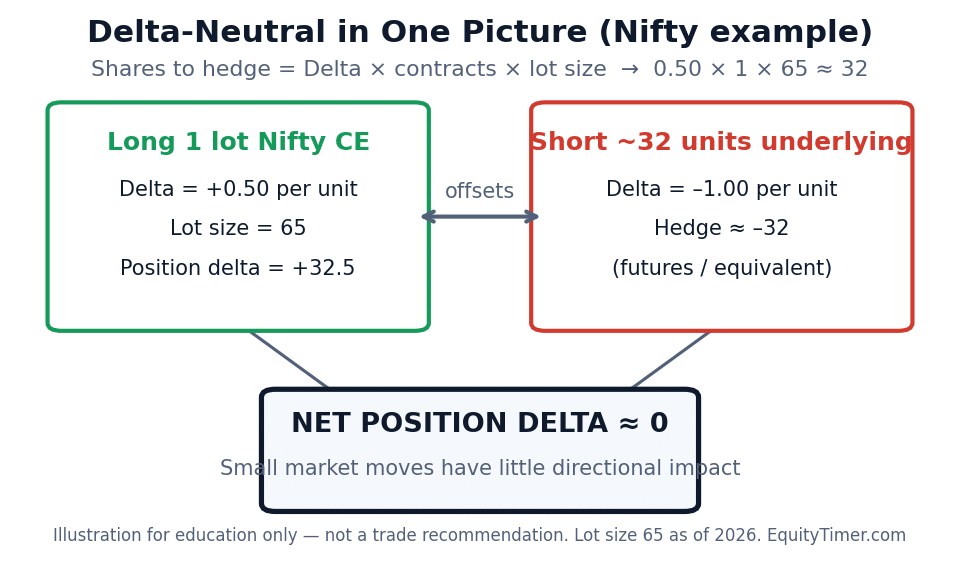
Units to hedge = Delta × number of contracts × lot size
A worked example on the Nifty, where the lot size is 65 units (2026 contracts; check the latest NSE circular before trading):
- You are long 1 lot of a Nifty call with Delta +0.50.
- Position Delta = 0.50 × 1 × 65 = +32.5.
- To go neutral, you would short about 32–33 units of the underlying exposure (in practice, via index futures or an offsetting option position, since you cannot short the index directly in the cash market).
At that point, small gains on one side are offset by small losses on the other, and the position is roughly insulated from minor market wobbles.
The same arithmetic scales: sell 8 calls of 0.25 Delta each and your position Delta is −200 per 100-unit convention (or in NSE terms, −0.25 × 8 × lot size); the hedge is the opposite quantity of the underlying.
Static vs dynamic hedging
Why one hedge is never enough
Suppose you set the hedge above and walk away. That is static hedging — one adjustment, then hands off. The problem: the moment the Nifty moves, Gamma changes your option’s Delta, and your carefully balanced position drifts away from neutral.
Continuing the example: the Nifty rallies and your call’s Delta rises from +0.50 to +0.60. Your position Delta is now 0.60 × 65 = +39, but your hedge is still −32. You are net +7 — quietly long again. To rebalance, you short roughly 6–7 more units. This continuous adjustment is dynamic hedging.
Dynamic hedging is powerful but not free. Each rebalance incurs transaction costs, and in fast markets Delta can shift faster than you can adjust. Volatile phases are precisely when hedges need the most maintenance — and when maintaining them costs the most. This is why delta hedging is generally considered a risk-management technique for experienced traders and institutions rather than a beginner strategy.
When traders reach for the hedge
Typical India-market situations
Delta hedging shows up most often in a few recognisable situations in the Indian market:
- Event risk. A trader wants to stay in a position through an RBI policy announcement, the Union Budget, or expiry week — but cannot afford a sharp adverse move. Neutralising Delta reduces the directional shock while keeping the position alive.
- Option sellers managing exposure. Sellers of straddles and strangles routinely trim Delta as the market drifts, keeping the position centred so profits come from time decay rather than direction.
- Protecting a portfolio without selling it. Selling stock to avoid a fall can trigger capital-gains tax (long-term gains above the exemption threshold are taxed at 12.5% under current rules). Hedging with index options can protect value while the holding stays intact — one reason professionals treat hedging cost as an insurance premium, not an expense.
- Market makers and desks. For institutions, delta-neutrality is the default operating state, rebalanced continuously through the day.
Practical cautions
Read before attempting
- Costs accumulate. Every rebalance pays brokerage, STT and slippage. A hedge that is adjusted too often can cost more than the risk it removes.
- Delta is model-dependent. Different platforms and volatility inputs produce slightly different Deltas. Treat the number as an estimate, not gospel — two professionals can hedge the same option with different quantities and both be internally consistent.
- Physical settlement. SEBI mandates physical settlement for stock derivatives. An ITM stock option carried to expiry can result in delivery obligations and additional margin. Index options (Nifty, Bank Nifty) are cash-settled, which is one reason hedgers prefer them.
- Over-hedging is real. If the expected move never comes, the hedge itself drags on returns. Hedging reduces variance; it does not create profit.
- Watch your Greeks together. Neutralising Delta leaves you exposed to Theta and Vega. A delta-neutral straddle can still lose heavily if implied volatility collapses.
Where to see and track Delta
Free, practical tools
You do not need to compute Delta by hand. The NSE option chain and most Indian broker platforms display Greeks per strike. Option-Greeks calculators let you input spot, strike, days to expiry, interest rate and implied volatility to see Delta (and how it shifts as you change the inputs — a genuinely useful way to build intuition). For portfolio work, most platforms show a net position Delta that updates live.
A simple habit that separates disciplined traders: check the net Delta of your option book at the start and end of each session. If the number surprises you, your exposure has drifted — exactly what this Greek exists to catch.
Frequently asked questions
Quick answers on hedging
What is delta hedging in simple words?
Delta hedging means offsetting an option position with an opposite position in the underlying (or another option) so the combined Delta is near zero. Small market moves then have little directional effect on the portfolio — like a seat belt that softens the impact rather than preventing the journey.
What is a delta-neutral position?
A position whose net Delta is at or near zero. It is largely insensitive to small directional moves, so its profit or loss comes from time decay, volatility changes, or Gamma instead of market direction.
How do I calculate how much to hedge on Nifty?
Units to hedge = Delta × contracts × lot size. With the Nifty lot at 65 (2026), one long 0.50-delta call carries +32.5 deltas, so the neutralising hedge is roughly 32–33 units of opposite underlying exposure, typically via futures.
Why does my hedge stop working after the market moves?
Because Gamma changes the option’s Delta as prices move, while your hedge quantity stays fixed. The position drifts away from neutral and needs rebalancing — that ongoing adjustment is called dynamic hedging.
Is delta hedging suitable for beginners?
Generally no. It requires constant monitoring, adds transaction costs with every rebalance, and demands a working grasp of Gamma, Theta and Vega. Beginners are usually better served understanding position Delta first and using defined-risk structures.
Are Nifty options cash-settled or physically settled?
Index options like Nifty and Bank Nifty are cash-settled. Stock derivatives, by contrast, are physically settled under SEBI rules — an ITM stock option carried to expiry can create delivery obligations and extra margin requirements.