Implied Volatility Explained: Why Your Option Loses Money Even When You’re Right
You can buy a call option, watch the Nifty rise exactly as you predicted, and still lose money. The hidden reason is implied volatility (IV) — the market’s forecast of future movement, baked into every option’s price. This guide explains what IV is, how India VIX lets you read it daily, why an “IV crush” can wipe out a correct trade, and which option buying and selling strategies traders commonly use in high-IV versus low-IV conditions. Written for education only, with Nifty examples and no buy, sell or hold advice.
The right-direction trap
Here is a story every options buyer knows. You expect the Nifty to rise, so you buy a call option. The next day the Nifty does rise — you were right. Yet when you check your position, the option has lost value. It feels broken. How can you be correct about direction and still lose money?
The answer is that an option’s price is driven by three forces, not one:
- Price of the underlying — the direction you predicted.
- Time to expiry — every day that passes drains a little value (time decay).
- Implied volatility — the market’s expectation of how much the underlying will move.
Most beginners watch only the first force. But the third — implied volatility — can move an option’s premium more sharply than a modest price move in your favour. When IV falls after you buy, it can quietly cancel out your gain from being right. Understanding IV is what separates traders who are puzzled by their losses from those who saw them coming.
What implied volatility really is
Implied volatility is the market’s forecast of how much an underlying — the Nifty, Bank Nifty, or a single stock — is expected to move over a set period. It is expressed as an annualised percentage, and it is “implied” because it is reverse-engineered from the prices at which options are actually trading right now. It is not calculated from past prices; it is extracted from present option premiums using a pricing model.
The cleanest way to picture it is insurance. Insuring a building in a flood zone costs more than insuring an identical building on a hill — because the expected risk is greater. Options work the same way: when the market expects large moves, option “insurance” becomes expensive, and IV is high. When calm is expected, options are cheap, and IV is low.
The critical point: IV reflects expected movement, not direction. High IV does not say the market will go up or down — only that it expects a big move either way. And because higher IV means higher premiums, the same option can cost very different amounts depending only on the IV environment.
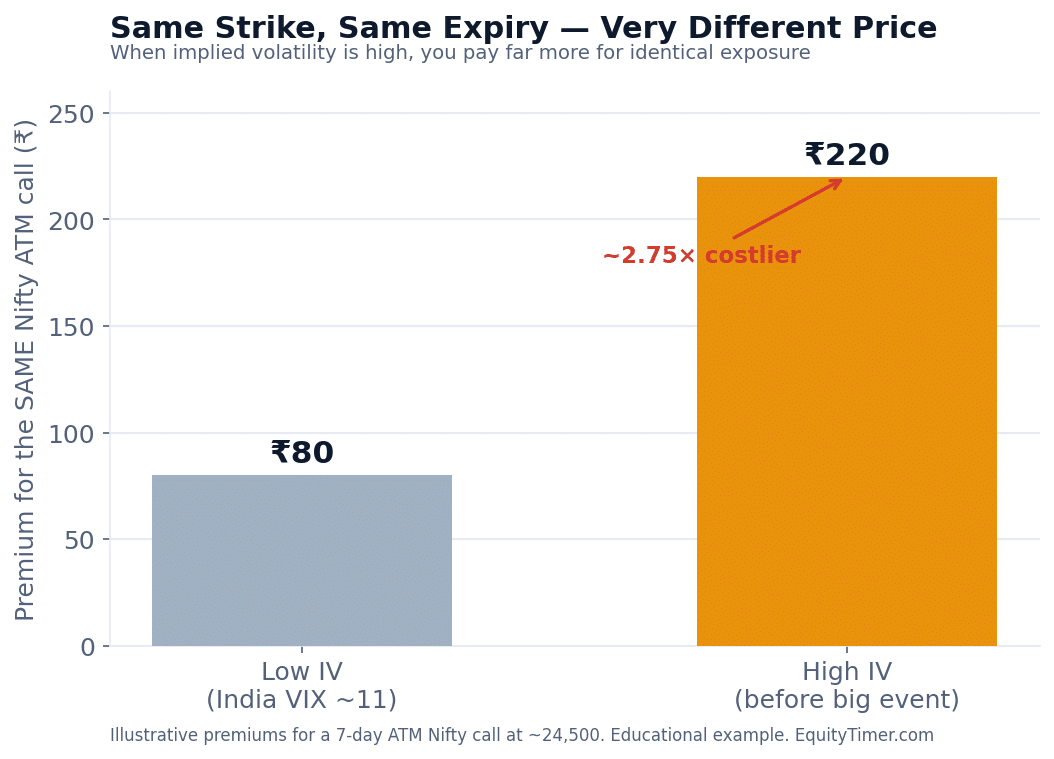
In the illustration above, one atthemoney Nifty call carries a premium near ₹80 in a calm, low-IV market, but around ₹220 ahead of a big event when IV is elevated — roughly 2.75 times more for the very same contract. Buy at the high price, and you start deep in the hole the moment volatility normalises.
India VIX: your daily IV gauge
You do not have to compute IV yourself to sense the market’s mood. India has a ready-made gauge: India VIX, introduced by the NSE in 2008 and derived from Nifty option prices. It estimates the expected volatility of the Nifty 50 over the next 30 days, and it is widely called the market’s “fear gauge.”
When India VIX is low, the market expects calm and option premiums are cheaper. When it spikes, the market is bracing for big moves and premiums swell. As a rough map of the territory:
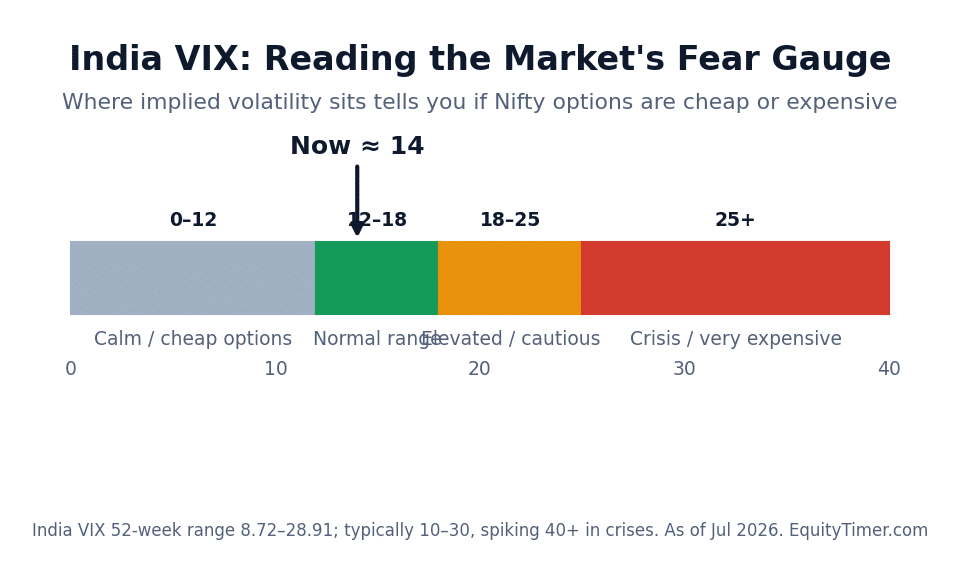
| India VIX level | What it usually signals | Effect on premiums |
|---|---|---|
| Below ~12 | Calm, complacent market | Options cheap |
| ~12–18 | Normal conditions | Fair premiums |
| ~18–25 | Elevated caution | Options getting expensive |
| Above ~25–30 | Fear, crisis, major events | Premiums very rich |
For context, over the year to July 2026 India VIX moved between roughly 8.72 and 28.91, trading around 13–14 in late July 2026 — a calm-to-normal reading. Historically it has spiked far higher in stress: above 40–50 during events such as the COVID-19 crash. Nifty’s own IV typically sits around 12–18% in ordinary markets.
Note: India VIX itself is not directly tradable — NSE discontinued VIX futures. Traders instead express a volatility view through Nifty option strategies, which is exactly what the next tabs cover.
IV crush: the silent killer
“IV crush” is the rapid collapse of implied volatility right after a known event passes — and it is the usual reason a directionally-correct option trade still loses. The mechanism is consistent:
- Before the event — an RBI policy decision, the Union Budget, quarterly results, or election results — uncertainty is high, so IV and premiums are inflated.
- After the event, the uncertainty is resolved. IV drops sharply, and the inflated portion of the premium evaporates — often within minutes.
A worked example. Suppose the Nifty is near 24,500 and you buy an atthemoney call before a big announcement, paying an event-inflated ₹220. The news lands and the Nifty rises modestly in your favour — but IV collapses back to normal. The fair premium is now around ₹120. You were right about direction and still lost roughly ₹100 of premium, because the volatility you overpaid for vanished.
This is why experienced traders are wary of buying naked options into a known event. Two common responses: avoid buying single options just before scheduled events, or use spreads instead of outright long options, so that IV crush hurts one leg but helps the other. Those strategy families are detailed in the next tabs.
Buyers versus sellers: the core split
Almost every volatility decision reduces to one idea:
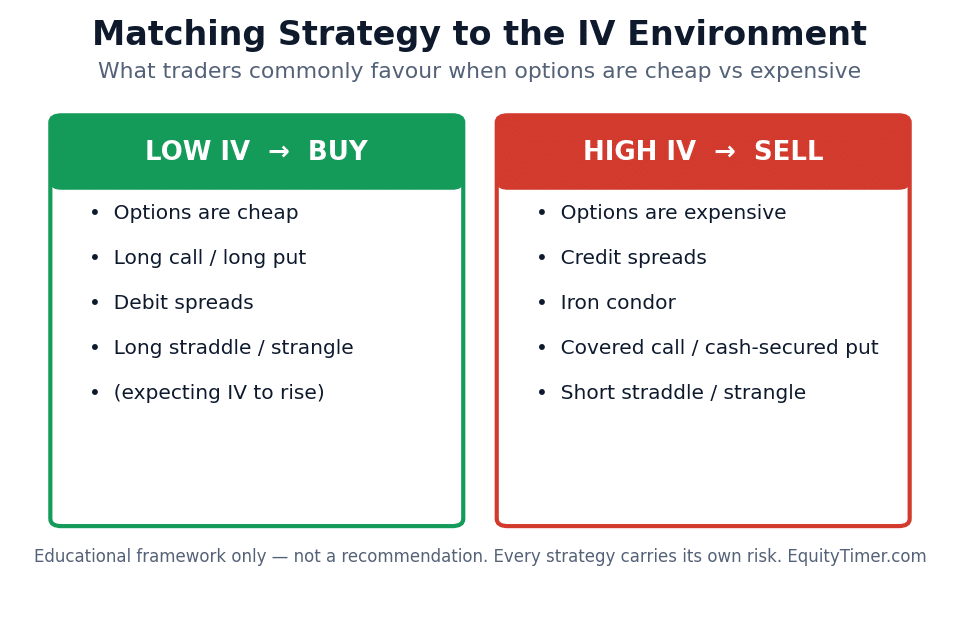
- When IV is LOW, options are cheap. That favours buyers — you pay little for the chance of a move, and if IV later rises, your option gains value on volatility alone.
- When IV is HIGH, options are expensive. That favours sellers — you collect a rich premium, and if IV falls (or the market simply stays calm), that premium decays in your favour.
The whole game, then, is to match your strategy to the IV environment rather than fight it. Buying expensive options and hoping is how correct forecasts still lose money; selling cheap options gives away edge. The quadrant below summarises the map, and the next two tabs walk through the specific strategies traders reach for on each side.
One caution before the specifics: “high” and “low” are relative to a stock’s own history, not absolute numbers. That is what IV Rank and IV Percentile measure — a natural next topic once this framework is clear.
Strategies traders use when IV is LOW
When implied volatility is low, options are inexpensive, so traders lean toward buying strategies — paying a small premium for the chance of a move, and often hoping IV itself expands. These are the families commonly used in low-IV conditions:
| Strategy | Market view | Why it suits low IV | Main risk |
|---|---|---|---|
| Long call | Bullish | Cheap premium; gains if price rises or IV expands | Loses to time decay if nothing moves |
| Long put | Bearish | Cheap downside exposure; benefits if IV rises | Time decay; needs the fall to come |
| Debit spread (bull call / bear put) | Directional | Lower cost than a naked option; defined risk | Capped profit; still needs the move |
| Long straddle / strangle | Big move, direction unknown | Profits from a large move either way, or from IV expansion | Loses if the market stays calm and IV falls |
The unifying logic: in a quiet market you are buying cheap optionality, and you often want volatility to increase after you enter. A long straddle placed before an anticipated jump in uncertainty is a classic low-IV expression — though it demands a genuinely large move to overcome the combined premium and time decay.
These are educational descriptions of how each strategy behaves in a low-IV environment — not recommendations to place any specific trade.
Strategies traders use when IV is HIGH
When implied volatility is high, premiums are rich, so traders lean toward selling strategies — collecting inflated premium and letting IV crush and time decay work in their favour. The trade-off is that selling generally carries larger or open-ended risk, so defined-risk structures are popular. Common high-IV families:
| Strategy | Market view | Why it suits high IV | Main risk |
|---|---|---|---|
| Credit spread (bull put / bear call) | Directional or neutral | Collects rich premium; defined, capped risk | Loss if price moves through the spread |
| Iron condor | Range-bound / neutral | Sells expensive OTM call and put spreads; profits from IV crush + decay | Loss if the market breaks out of the range |
| Covered call | Mildly bullish / holding stock | Rich premium boosts income on a holding you own | Caps upside; stock can still fall |
| Cash-secured put | Willing to own lower | High premium collected while waiting to buy lower | Obliged to buy if price falls below strike |
| Short straddle / strangle | Expects calm / IV drop | Maximum premium collection; benefits most from IV crush | Open-ended risk if a big move occurs |
The unifying logic mirrors the low-IV case in reverse: you are selling expensive optionality and want the market to calm down, so that inflated premium decays. Iron condors and credit spreads are especially popular around events precisely because they turn the IV crush that punishes buyers into a tailwind — while capping the risk that naked selling would leave open.
Selling options can involve substantial or unlimited risk and margin. This is an educational overview of high-IV strategy families, not a recommendation to sell options.
Key takeaways
- Three forces, not one. An option’s price moves with the underlying, with time, and with implied volatility. Watching only direction is why correct forecasts still lose.
- IV is expected movement, not direction. High IV means a big move is expected either way, and it makes every option more expensive.
- Read India VIX before you trade. It is a free daily gauge of whether Nifty options are cheap or expensive right now.
- Respect IV crush. Buying naked options into a known event — RBI policy, Budget, results — is how premium evaporates even when you are right.
- Match strategy to environment. Low IV tilts toward buying (long options, debit spreads, straddles); high IV tilts toward selling (credit spreads, iron condors, covered calls).
Implied volatility is not an advanced extra — it is the missing piece that makes option prices finally make sense. Check it as routinely as you check price, and the “I was right but still lost” experience becomes far rarer.
Frequently asked questions
Why did my option lose money when the stock moved in my favour?
Most likely because implied volatility fell after you bought. An option’s price depends on the underlying’s move, time decay, and IV. If IV drops — often after a known event — the premium can shrink faster than a modest favourable price move can lift it, so you lose even though your direction was right.
What is a good IV level to buy options?
Generally, buyers are favoured when IV is low relative to the underlying’s own recent history, because options are cheap and IV may expand. “Low” is relative, not an absolute number — tools like IV Rank and IV Percentile measure where current IV sits versus its past year. This is educational context, not a signal to trade.
What is India VIX and how do I use it?
India VIX is the NSE’s volatility index, derived from Nifty option prices, estimating expected 30-day Nifty volatility. A low reading suggests calm and cheaper options; a high reading suggests fear and expensive options. Traders use it to judge whether option premiums are currently cheap or rich before choosing a strategy.
What is IV crush and how do I avoid it?
IV crush is the sharp drop in implied volatility right after a known event (RBI policy, Budget, results). It deflates option premiums quickly. Buyers avoid it by not purchasing naked options just before such events, or by using spreads — where the crush hurts one leg but helps the other — instead of outright long options.
Which option strategy is best in high IV?
High IV generally favours premium-selling strategies, because premiums are rich and can decay as IV normalises. Defined-risk structures such as credit spreads and iron condors are commonly used, since they collect inflated premium while capping risk. What is “best” depends on your view and risk tolerance; this is educational, not advice.
Can I trade India VIX directly?
Not directly — NSE discontinued India VIX futures, so there is no live VIX contract to buy or sell. To express a view on volatility, traders instead use Nifty option strategies whose value responds to changes in implied volatility.
Educational and informational content only. EquityTimer is not a SEBI-registered investment adviser and does not provide buy, sell or hold recommendations. Options trading involves substantial risk and is not suitable for everyone; selling options can involve unlimited risk. Figures (including India VIX levels and illustrative premiums) are as of 2026 and may change. Verify data independently and consult a registered financial adviser before making any trading or investment decision.